Recently, the Nanophotonics Research Team at Guangxi University reported new advances in the study of ferroelectricity in chiral hybrid perovskites. The findings, titled “Surface Ferroelectricity in Lead-Free Nonferroelectric Chiral Perovskites Beyond Neumann’s Principle,” were published in Angewandte Chemie International Edition.
Yang Zhi, a 2023 master’s student from the School of Physical Science and Engineering Technology, is the first author. The corresponding authors are Professor Zeng Ruosheng from the same school and Professor Zou Bingsuo from the School of Resources, Environment and Materials. Guangxi University is the first and sole corresponding institution of the paper.
Sb(III)-based hybrid perovskites exhibit intrinsic polarity arising from lone pair–induced octahedral distortion. However, as they belong to nonferroelectric space groups, they cannot generate macroscopic polarization, which limits their application in self-powered circularly polarized light (CPL) detection.
To address this limitation, the GXU Nanophotonics Team reported the first observation of surface ferroelectricity in one-dimensional chiral nonferroelectric R/S-MPZSbBr₅. This phenomenon originates from translational symmetry breaking at the {001} crystal facet, where the termini of antiparallel Sb–Br chains become exposed, preventing the cancellation of local dipole moments and resulting in spontaneous polarization. The surface polarization couples with chirality, giving rise to a pronounced circular photovoltaic effect. The device can distinguish left- and right-handed circularly polarized light under zero bias, achieving anisotropy factors (g_res) of −0.39 and 0.37. In addition, the synergistic surface ferroelectric–pyroelectric effect enhances the responsivity by 1.8 times.
By analyzing ferroelectricity from the perspective of nonzero surface dipoles, this study moves beyond the constraints of Neumann’s principle and challenges the conventional view that ferroelectricity must arise from ferroelectric space groups. The findings provide a new materials platform for low-power, high-sensitivity self-powered optoelectronic chips and quantum information devices, and expand research on chiral hybrid perovskites in ferroelectricity and polarization detection.
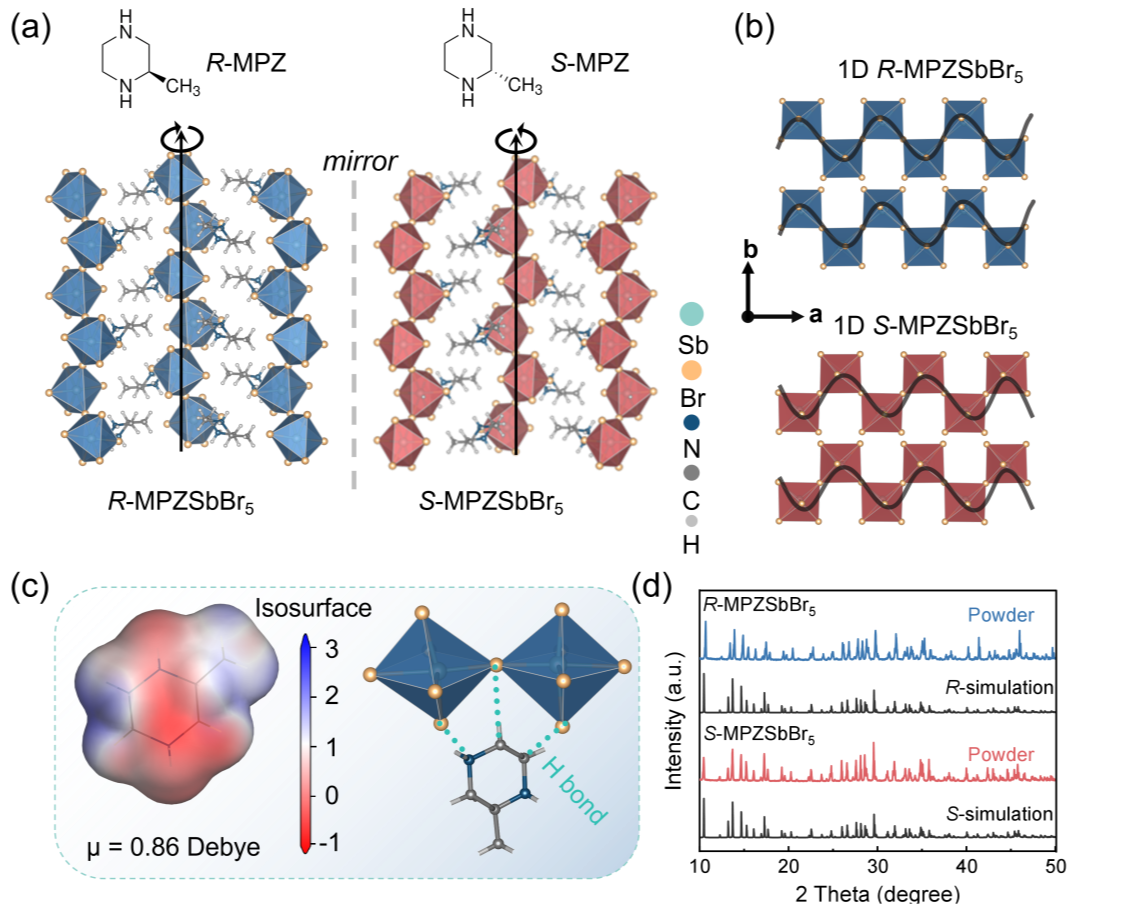
Figure 1. Structural characterization of R/S-MPZSbBr₅.

 Address: No.100,East Daxue Road,Xixiangtang District,Nanning, Guangxi,China
 Postal Code: 530004
 Tel: 86-771-3238863
 Email: gjc@gxu.edu.cn