Recently, the research team led by Professor Luo Nengneng from the School of Resources, Environment and Materials at GXU made new progress in dielectric ceramic materials. The team successfully developed composite dielectric ceramics featuring both high energy-storage density and excellent temperature stability, and fabricated multilayer ceramic capacitors (MLCCs).
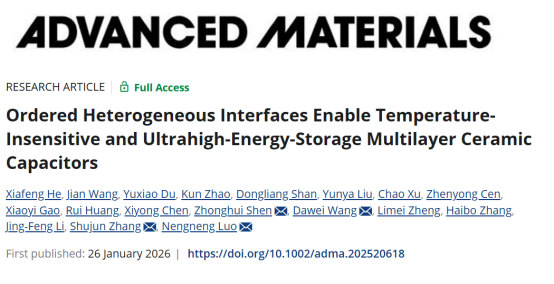
The related study, titled “Ordered Heterogeneous Interfaces Enable Temperature-Insensitive and Ultrahigh-Energy-Storage Multilayer Ceramic Capacitors,” was published in Advanced Materials. He Xiafeng, a doctoral candidate from the School, is the first author, and Professor Luo Nengneng is the corresponding author. Co-corresponding authors include Professor Shen Zhonghui of Wuhan University of Technology, Professor Wang Dawei of Harbin Institute of Technology, and Professor Zhang Shujun of City University of Hong Kong. Collaborating institutions also include Shandong University, Xiangtan University, The Hong Kong Polytechnic University, Huazhong University of Science and Technology, and Tsinghua University.
As the need for device miniaturization, integration, and high-temperature operation—particularly above 150°C—become increasingly urgent, developing dielectric materials that combine high energy-storage density with excellent thermal stability has emerged as a key challenge. Enhancing both the two properties of MLCCs is therefore a central focus.
To address this issue, Professor Luo Nengneng’s team proposed a new strategy: embedding parallel-aligned Al₂O₃ plate-like templates into a lead-free relaxor ferroelectric matrix to construct a large number of ordered heterogeneous interfaces. Under high electric fields and elevated temperatures, these interfaces effectively suppress charge injection and transport, significantly reducing electrical conductivity and energy loss, thereby achieving high breakdown strength and thermal stability.
With this design, the breakdown strength and energy-storage density of the composite bulk ceramics were enhanced by 2.6 and 2.2 times, respectively, while the variation in energy density over 20°C–160°C decreased from ~10% to ~2%. Notably, MLCCs fabricated from this dielectric material exhibited a breakdown strength of up to 1140 kV cm⁻¹ and an energy-storage density of 16.0 J cm⁻³. The devices also demonstrated excellent thermal stability across 20°C–160°C, with performance fluctuations within 3%. These results highlight the potential of ordered heterogeneous interface engineering for developing materials with both high energy density and strong thermal stability.
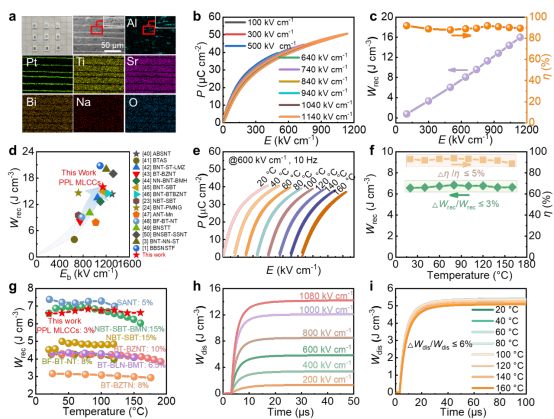
Figure. Composite dielectric multilayer ceramic capacitors with embedded Al₂O₃ platelets and their energy-storage performance.
This research was supported by the National Natural Science Foundation of China, the Guangxi Distinguished Young Scientists Fund, the Guangxi Science and Technology Development Special Fund, and the Guangxi Bagui Young Talent Program.

 Address: No.100,East Daxue Road,Xixiangtang District,Nanning, Guangxi,China
 Postal Code: 530004
 Tel: 86-771-3238863
 Email: gjc@gxu.edu.cn