Recently, the Advanced Wood Fiber Materials Research Group at the GXU School of Light Industry and Food Engineering reported significant progress in self-powered sensors. Their findings, titled “Bioinspired triboelectric droplet sensor for ammonia monitoring,” were published in Nature Communications. The first author of the paper is Liu Tao, a 2022 doctoral candidate at the School, and the corresponding author is Professor Nie Shuangxi of the same school. GXU is the sole affiliated institution of the study.
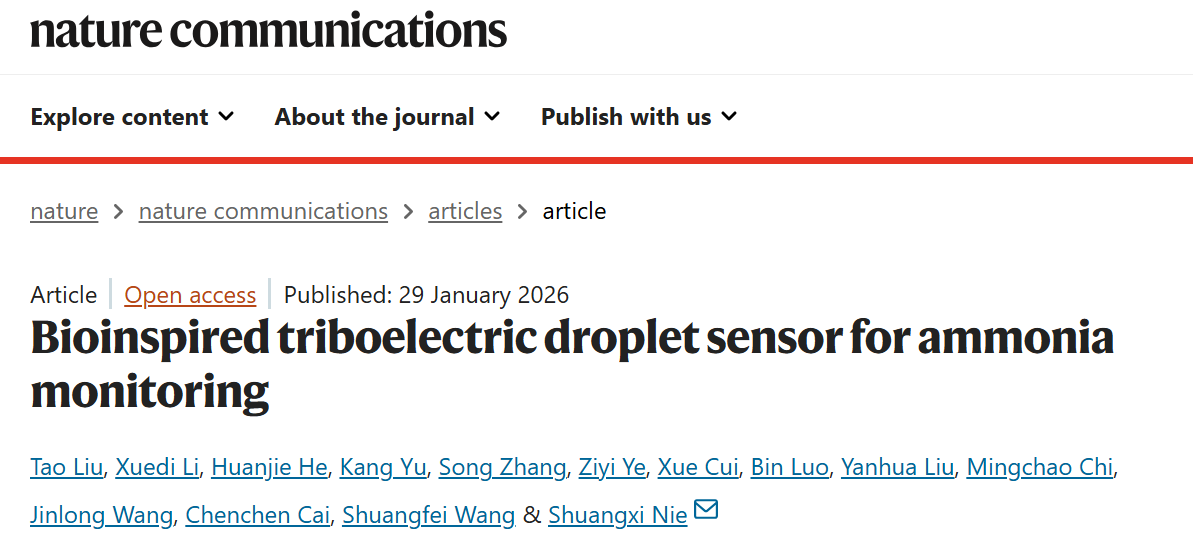
Approximately 183 million tons of ammonia are produced globally each year, about 80% of which is released into the atmosphere, with applications and emissions spanning industrial, agricultural, and medical sectors. Ammonia is a colorless gas with strong irritant properties, corrosiveness and toxicity. Prolonged exposure to concentrations exceeding 50 ppm can cause severe respiratory diseases and, in extreme cases, death. Efficient and accurate detection of ammonia is therefore of great importance to environmental protection and human health. However, slow response time remains a major technical bottleneck in existing ammonia sensors, limiting their performance in high-precision applications.
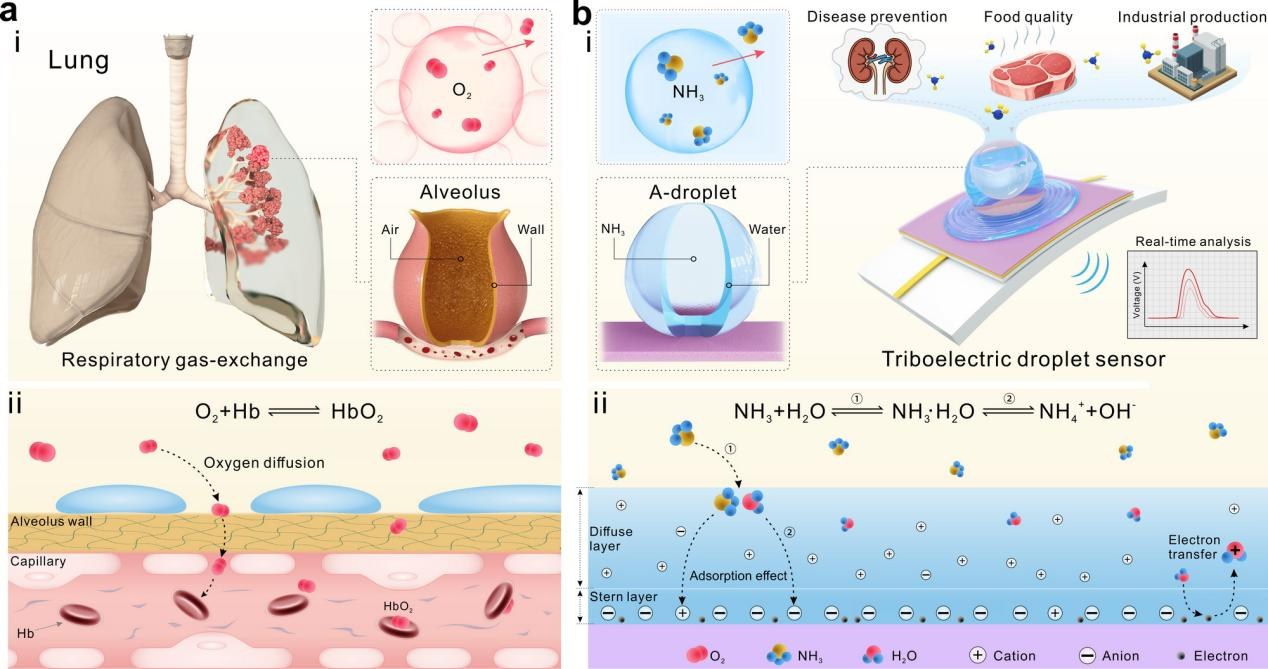
To address this challenge, the research team drew inspiration from the structure of pulmonary alveoli and their gas exchange mechanism to develop a hollow droplet (A-droplet)–driven gas sensor. The device achieves rapid response through instantaneous electron transfer at the liquid–solid interface, without relying on gas adsorption–desorption reactions. This hydroelectric sensing mechanism enables an ultrafast response time, surpassing that of mainstream ammonia sensors.

 Address: No.100,East Daxue Road,Xixiangtang District,Nanning, Guangxi,China
 Postal Code: 530004
 Tel: 86-771-3238863
 Email: gjc@gxu.edu.cn